
Part No. Rotary Servo Base Unit
Quanser Rotary Servo Base Unit is a modular control experiment platform for teaching servo motor control concepts using a DC motor and encoder.
Rotary Servo Base Unit
Foundational modular control experiment
The Rotary Servo Base Unit is the fundamental element of the Quanser Rotary Control family. It is ideally suited to introduce basic control concepts and theories on an easy-to-use and intuitive platform. Use it on its own to perform several experiments or expand the scope of this unit by adding on other modules to teach an even wider range of control concepts. Instructors can thus expose students to a variety of rotary control challenges for a minimal investment. Real-world applications of the rotary servomotor include the autofocus feature in modern cameras, cruise control in automobiles, and servo actuation in aerospace.
The Rotary Servo Base Unit is a geared servo-mechanism system. The plant consists of a DC motor in a solid aluminum frame. This DC motor drives the smaller pinion gear through an internal gear box. The pinion gear is fixed to a larger middle gear that rotates on the load shaft. The position of the load shaft can be measured using a high resolution optical encoder or a potentiometer. The encoder is also used to estimate the speed of the motor.
| Specifications |
|
| Plant dimensions (L x W x H) | 15 x 15 x 18 cm |
| Plant Mass | 1.2 kg |
| Motor Nominal Input Voltage | 6 V |
| Motor Maximum Continuous Current (Recommended) | 1A |
| Motor Maximum Speed ( Recommended) | 6,000 RPM |
| Potentiometer Bias Power | +12 V |
| Potentiometer Measurement Range | +5 V |
| Encoder Resolution (in quadrature) | 4096 counts/revolution |
• High-quality DC servo motor and gearbox
• High-resolution optical encoder to sense position and estimate motor speed
• Continuous turn potentiometer to sense position
• Variable loads and gear ratios
• Optional slip ring for continuous measurement from instrumented modules
• Ten add-on modules available
Modeling Topics
• First-principles derivation
• Experimental derivation
• Transfer function representation
• Frequency response representation
• Model validation
Control Topics
• PID
• Lead Compensator
QLabs Virtual Rotary Servo is a digital twin platform for control systems education, enabling realistic DC motor control labs with MATLAB/Simulink.
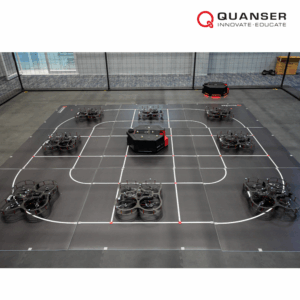
Autonomous Vehicles Research Studio by Quanser helps universities quickly build an indoor robotics research lab using QDrone 2, QBot Platform, and integrated vision systems.
สำหรับใช้ในการทดลอง ไม่ว่าจะเป็นด้านพลศาสตร์ของโครงสร้าง การจำลองการเคลื่อนไหว การศึกษาการสั่นสะเทือน สามารถประยุกต์ใช้กับเทคโนโลยีในการกายภาพบำบัด รวมถึงการวิจัยในอีกหลากหลายรูปแบบ
ระบบ Quanser Aero 2 ใช้โรเตอร์จำนวน 2 ตัวในการสร้างแรงขับ และช่วยให้ผู้ใช้งานสามารถควบคุมการตอบสนองทางพลศาสตร์ของระบบได้อย่างปลอดภัย ใบพัดถอดเปลี่ยนได้ ทิศทางของแรงขับสามารถปรับได้โดยผู้ใช้
บริษัท เอ็นเทค อินดัสเทรียล โซลูชั่น จำกัด
17/121 ซอยงามวงศ์วาน 47 แยก 48 แขวงทุ่งสองห้อง
เขตหลักสี่ กรุงเทพฯ 10210
กรุณาระบุจำนวนสินค้าที่คุณต้องการ แล้วกดปุ่มด้านล่าง
จำนวน
กรุณาทำการลงทะเบียนเพื่อเป็นสมาชิก โดยสมาชิกสามารถดาวน์โหลดคู่มือการใช้งาน
รวมถึงได้รับความสะดวกสบายในการขอใบเสนอราคา